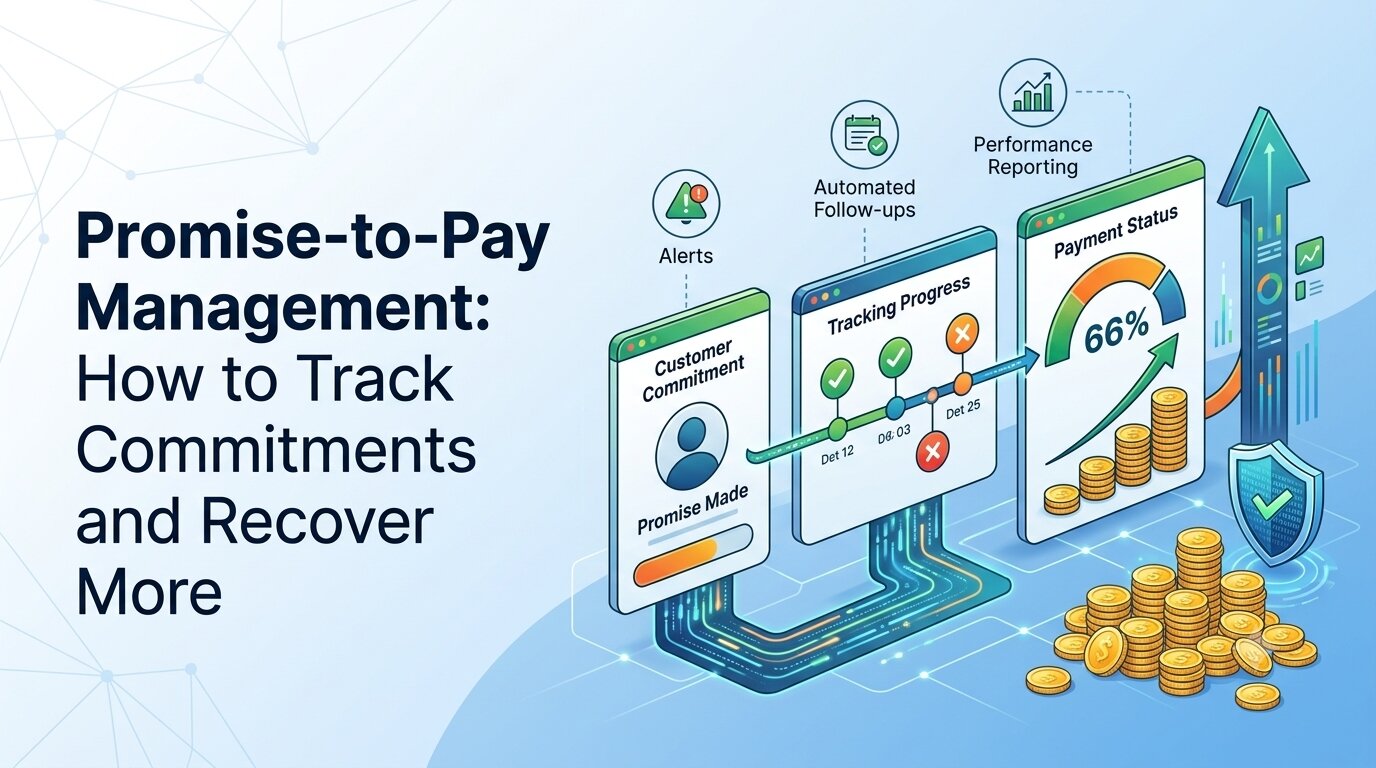
A promise to pay sounds simple: a debtor agrees to pay a specific amount by a specific date. For a collections team, however, that promise is only useful if it is recorded, monitored, and followed up at the right time.
When promises are tracked manually or across disconnected systems, important commitments can easily be missed. An agent may forget to follow up, a promised payment may go unnoticed after its due date, or another team member may not know about an earlier commitment.
This is where structured promise-to-pay (PTP) management becomes important. By giving collections teams a clear way to record, monitor, and act on payment commitments, organisations can make follow-up more consistent and gain a better view of expected recoveries.
What Is Promise-to-Pay Management?
A promise-to-pay is a commitment made by a debtor to pay a specific amount within an agreed timeframe.
For example, a customer with an overdue balance of AED 10,000 might agree to pay AED 3,000 by 30 September and settle the remaining amount later. That commitment creates a specific follow-up point for the collections team.
PTP management is the process of recording and monitoring these commitments throughout the collections lifecycle.
It generally sits between contact and payment:
Customer contact → PTP recorded → Follow-up → Payment received or promise broken → Next action
The important part is what happens after the promise is made. A PTP should not simply remain as a note in an agent's records. It should become a tracked event with a clear amount, date, status, and next action.
Why Does Promise-to-Pay Tracking Break Down?
The problem is often not the collection team's willingness to follow up. It is the way information is recorded and managed.
Manual tracking creates gaps
Spreadsheets, individual notes, email reminders, and separate agent records can make it difficult to maintain a complete picture of outstanding promises.
As the number of accounts grows, manually checking every promised payment becomes increasingly difficult. Information can also become outdated when several agents work on the same accounts.
Missed dates lead to missed follow-ups
A promised payment date is a natural point for action. If there is no reminder or alert, an agent may not realise that the date has passed until much later. That delay matters. The longer a broken promise remains unattended, the more difficult it may become to understand what happened and decide on the next appropriate action.
Teams may lack a shared view
Imagine that one agent records a promise while another agent later contacts the same customer. Without a central record, the second agent may not know about the previous commitment.
A shared PTP record gives the team visibility into:
- What amount was promised
- When payment was expected
- Whether the payment was received
- How many previous promises were made
- Whether the account requires another action
Historical patterns can be overlooked
One broken promise does not necessarily tell the whole story. Some customers may consistently honour their commitments, while others may make several promises without completing payment. If this history is not captured and analysed, agents may treat both situations in exactly the same way. Over time, that can make collection strategies less targeted.
The Real Cost of Poorly Managed PTPs
The impact of weak PTP management goes beyond a missed reminder.
Missed follow-ups can delay recovery
When a payment does not arrive on the promised date, the collections team needs to know quickly so it can decide what happens next. A delayed follow-up can push an account further into the collections cycle and reduce the value of the original commitment.
Agents spend time checking records
Collections agents should spend their time speaking with customers and resolving accounts, not repeatedly searching spreadsheets or different systems to find out which promises are due. Automated alerts can reduce some of this administrative work by bringing upcoming and overdue commitments to the agent's attention.
Expected cash flow becomes harder to forecast
PTPs can also provide useful information for collections planning. If a team has a record of active commitments, managers can see the amount customers have agreed to pay and when those payments are expected. However, these figures should be treated as expected collections rather than guaranteed cash inflows, because a promise may still be broken.
Best Practices for Tracking Payment Commitments
A structured approach can make PTP management easier to control and measure.
1. Keep every PTP in one system
Each promise should be recorded in a central system rather than being scattered across spreadsheets, emails, or personal notes.
At a minimum, the record should capture:
- Customer or account details
- Promised amount
- Promise date
- Date the promise was made
- Payment status
- Agent responsible
- Previous PTP history
- Next follow-up action
This creates a consistent record that can be accessed by authorised members of the collections team.
2. Use reminders around the promise date
A reminder before the due date can help agents prepare for follow-up. An alert after the due date can highlight commitments that need attention. The exact timing can depend on the organisation's collection process and the type of account. The goal is straightforward: a promise should trigger an action, not disappear into a record.
3. Look at PTP history
A customer's previous commitments can provide useful context for future collection activity.
For example, a debtor who has consistently honoured previous promises may require a different follow-up approach from someone who has repeatedly missed agreed dates.
This does not mean automatically treating customers differently based on assumptions. It means giving agents relevant account history so they can make better-informed decisions.
4. Define escalation rules
A broken promise should have a clear next step.
Depending on the organisation's policies, that might involve:
- Creating a follow-up task
- Reassigning the account
- Increasing contact frequency
- Moving the account to another collection stage
- Reviewing the account for legal or other escalation
Clear rules help prevent broken commitments from sitting unattended.
5. Give managers a real-time view
Collections managers need more than individual account records. They also need to understand what is happening across the portfolio.
A dashboard can show information such as:
- Active PTPs
- Payments received against PTPs
- Upcoming commitments
- Broken promises
- Overdue follow-ups
- PTP conversion trends
- Amounts expected versus collected
This makes it easier to identify bottlenecks and decide where management attention is needed.
How Technology Can Improve PTP Management
Technology does not make a payment commitment more reliable by itself. Its value comes from making the process easier to monitor and act on consistently. A collections platform can connect several parts of the PTP process.
Automated tracking
Instead of relying on agents to remember every commitment, the system can automatically record the PTP and track its status. This creates a clear history from the original promise through to payment, missed commitment, or further action.
Predictive insights
Some collections platforms can also use historical account information to identify patterns associated with payment behaviour.
For example, previous PTP outcomes can become one of several signals used to assess the likelihood of a future commitment being honoured.
Such scoring should support human decision-making rather than replace it. Collections teams still need to consider the customer's circumstances, account history, applicable policies, and regulatory requirements.
Communication linked to PTP dates
PTP management becomes more useful when reminders and collection activities are connected to the commitment itself.
Depending on the organisation's communication strategy and applicable consent and regulatory requirements, this may include channels such as:
- SMS
- Voice calls
- Push notifications
Instead of sending generic reminders, communication can be scheduled around relevant payment dates and collection stages.
Where Debtics fits
Debtics, the Smart Debt Collection platform from Beveron, brings PTP tracking into a broader collections workflow.
It can help collections teams record payment commitments, monitor their status, manage follow-ups, and track broken promises within the same system. Communication channels such as SMS, email, WhatsApp, IVR, and push notifications can also be incorporated into collection workflows.
For teams managing a large number of accounts, this can reduce the need to maintain separate PTP records and manually check every promised payment.
The wider value is visibility: agents can see the status of an account, while managers can monitor collection activity across the portfolio.
Key Metrics to Measure PTP Performance
Tracking PTPs is only the first step. Collections teams also need to measure whether their process is working as intended.
PTP-to-payment conversion rate
This measures the proportion of recorded promises that result in the agreed payment.
A simple calculation is:
PTP-to-payment conversion rate = Completed PTPs ÷ Total PTPs × 100
For example, if 800 out of 1,000 recorded promises result in payment, the conversion rate is 80%.
Teams should define what counts as a completed PTP consistently. A partial payment, late payment, or revised commitment may need to be treated differently depending on the organisation's reporting rules.
Average days to broken promise
This metric can help teams understand how quickly commitments tend to fail.
It can be calculated by measuring the number of days between the promised payment date and the point at which the PTP is formally classified as broken, then averaging those values across relevant accounts.
The definition should remain consistent so that trends can be compared over time.
Recovery rate after structured PTP tracking
Teams can also compare recovery performance before and after introducing a more structured PTP process.
However, this needs to be interpreted carefully. Changes in recovery rates may also be influenced by account mix, economic conditions, customer behaviour, collection strategies, and other operational changes.
Rather than attributing every improvement to PTP tracking alone, organisations should look at several measures together.
Turning a Promise Into a Measurable Collection Action
A promise to pay is more than a note from a customer conversation. It is a commitment that creates a specific amount, date, and follow-up requirement.
When those commitments are tracked manually, important actions can be missed. When they are captured in a structured system, collections teams have a clearer way to monitor upcoming payments, identify broken promises, understand account history, and decide what should happen next.
The goal is not simply to record more promises. It is to make every commitment visible and actionable.
For collections teams looking to bring PTP tracking, follow-ups, communication, and account management into one workflow, Debtics can provide a central platform for managing the process from commitment to recovery.
FAQs
1. What is promise-to-pay (PTP) management?
Promise-to-pay management is the process of recording, tracking, and following up on a debtor’s commitment to pay a specific amount by an agreed date.
2. How can automated PTP tracking improve debt collection?
Automated PTP tracking helps teams monitor upcoming and overdue commitments, send timely reminders, identify broken promises, and reduce manual follow-up work.
3. What metrics should collections teams track for PTP performance?
Key metrics include the PTP-to-payment conversion rate, number of broken promises, average days to a broken promise, and recovery rates after structured PTP tracking.
Best promise-to-pay management software for banks in the UAE
Best automated payment reminders for finance teams in the UAE
Best debt collection software for institutes in the UAE