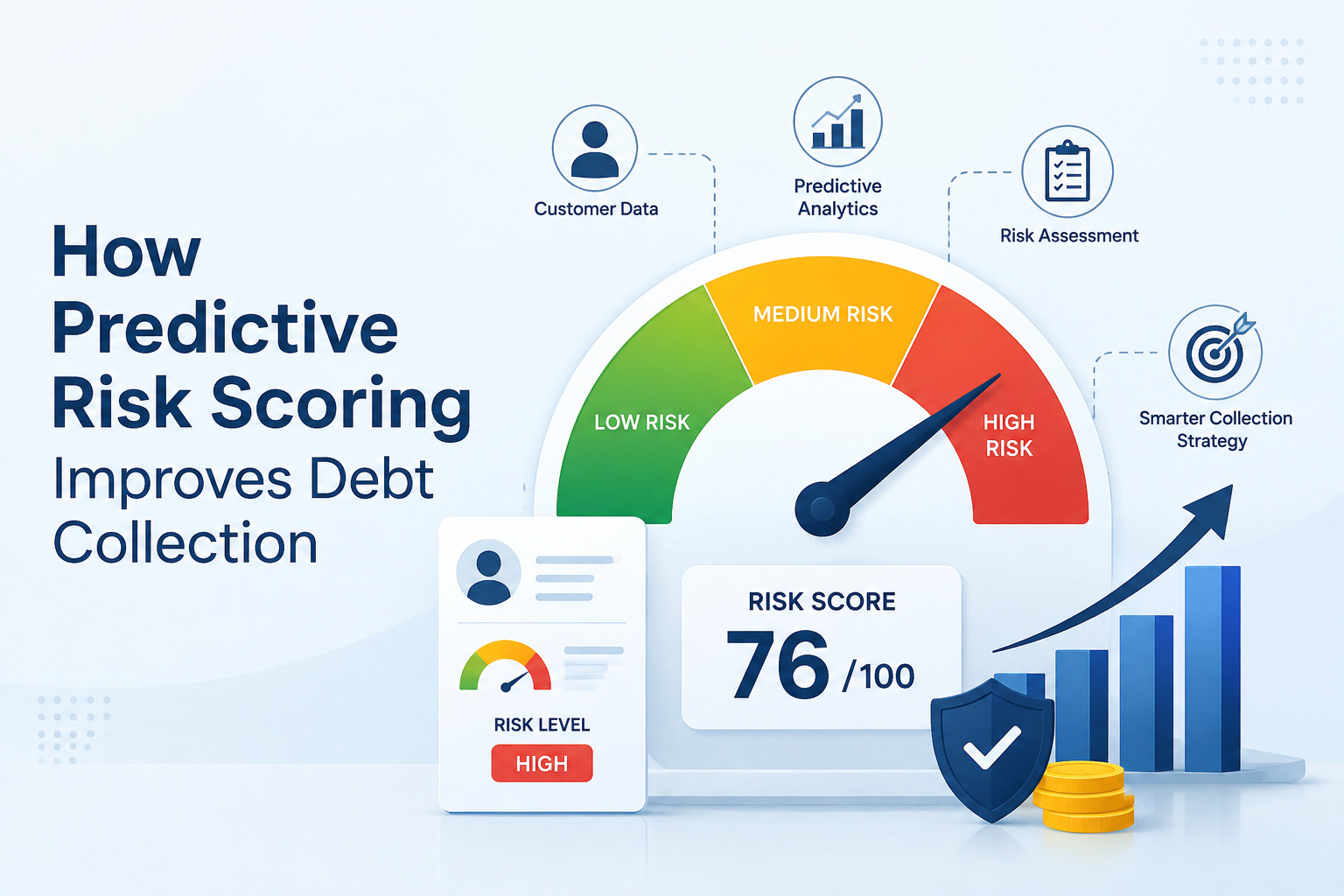
Managing overdue accounts is rarely as simple as making a list and working through it from top to bottom. A collection team may have hundreds or even thousands of accounts to follow up, each with a different payment history, outstanding balance and level of responsiveness.
The real challenge is deciding which account deserves attention first.
This is where predictive risk scoring can make a difference. Instead of treating every overdue account in the same way, collection teams can use available account data to identify patterns, assess recovery likelihood and organise their workload around the accounts that need attention most.
For businesses managing large receivables portfolios, this approach can turn a long list of overdue accounts into a more focused collection strategy. Platforms such as Debtics bring this idea into the daily collection workflow through prioritised queues, debtor segmentation and weighted recovery-likelihood scoring.
What Is Predictive Risk Scoring in Debt Collection?
Predictive risk scoring is a way of using account information to estimate how an account may behave in the future.
In debt collection, the goal is not simply to identify who owes money. It is to understand which accounts are more likely to respond, pay or require further action, so collectors can use their time more effectively.
A scoring system may consider information such as:
- Outstanding balance
- Days past due
- Previous payment behaviour
- Communication and response history
- Promises to pay
- Other relevant account or customer information
Predictive analytics can analyse historical data and identify patterns that may indicate future payment behaviour. In collection software, these insights can then be converted into scores or account segments that help teams decide where to focus their efforts.
It is important to remember that a score is a decision-support tool, not a guarantee that an account will or will not pay. Collectors still need to consider the circumstances of individual accounts.
Why Traditional Account Prioritisation Falls Short
Many collection teams still rely on simple methods to decide which accounts to contact first.
For example, they might start with the oldest overdue invoices, work through accounts according to their outstanding balance or simply follow a spreadsheet in the order it was created. These methods can work for smaller portfolios, but they become harder to manage as the number of accounts grows.
Consider two accounts:
-
Account A: AED 50,000 outstanding and 90 days overdue, but the customer has stopped responding to repeated communication.
-
Account B: AED 20,000 outstanding and 30 days overdue, with a strong payment history and a recent promise to pay.
Looking only at the balance or days past due does not provide the complete picture. This is the problem with basic prioritisation. It can tell collectors what is overdue, but not necessarily where their next effort is most likely to produce a useful result. Predictive risk scoring adds another layer of information to that decision.
How Predictive Risk Scoring Works
The exact method varies between systems, but the general process is straightforward.
1. Collect Relevant Account Data
The first step is bringing together information that can help explain an account's behaviour. This may include payment history, outstanding amounts, days past due, previous contact attempts and responses.
The more reliable and relevant the data, the more useful the resulting assessment can be.
2. Identify Patterns
The system looks for patterns across existing account data. For example, historical information may show that certain combinations of payment behaviour, account age and responsiveness are associated with better or poorer recovery outcomes.
This is something that can become difficult for a human collector to identify when they are managing a large portfolio manually.
3. Assign a Score
The system can then assign a risk or recovery-likelihood score to an account. The score helps distinguish between accounts that may deserve immediate attention and those that can be handled through a different collection approach.
The important point is that the score gives collectors another piece of information to consider instead of relying entirely on balance, ageing or personal judgement.
4. Turn Scores Into Collection Priorities
A score becomes much more useful when it is connected to an actual workflow. Rather than giving collectors another report to review, the system can use scoring to help organise their work queue.
Debtics, for example, provides a prioritised collection queue with a next-best action and preferred channel for each account. Its accounts are segmented into Soft Touch, Warm Chase, Firm Action, Legal Track and Write-Off, with weighted recovery-likelihood scoring used alongside balance and days past due.
That means the insight can move directly from the data into the collector's daily workload.
7 Ways Predictive Risk Scoring Helps Collection Teams Prioritise Accounts
1. Focus on Accounts With Higher Recovery Potential
The biggest advantage is better focus. Instead of spending the same amount of time on every overdue account, teams can identify accounts that appear more likely to respond or recover based on available information.
This does not mean ignoring other accounts. It means making better decisions about where human effort should go first.
2. Reduce Time Spent on Low-Priority Accounts
Collectors often spend valuable time manually reviewing accounts before deciding what to do next. When accounts are already scored or segmented, some of that decision-making can happen earlier in the process.
Routine accounts can follow standard reminder sequences, while collectors can spend more time on accounts that need personal attention. This is particularly useful when a small team is responsible for a large portfolio.
3. Improve Collector Productivity
A collector's day can quickly become fragmented by switching between spreadsheets, emails, customer records and payment information. A prioritised queue gives them a clearer starting point.
Instead of asking, “Which account should I work on now?”, the collector can start with the accounts already identified as higher priority and follow the recommended next step.
Debtics is designed around this type of workflow, giving agents a prioritised worklist and showing the next best action and preferred communication channel for each account.
4. Match Collection Effort to Account Risk
Not every debtor needs the same type of communication. One customer may respond well to a simple reminder. Another may require a phone conversation, a payment arrangement or escalation. Risk scoring and segmentation can help teams avoid using a single approach for every account.
For example, Debtics separates accounts into different collection segments, including Soft Touch, Warm Chase and Firm Action, while also providing Legal Track and Write-Off categories.
This creates a more structured way to decide how much attention an account should receive.
5. Identify Accounts That Need Early Intervention
A useful collection strategy is not only about recovering old debts. It is also about identifying problems before they become more difficult to resolve. If account behaviour suggests that a payment may be delayed or an account is becoming more difficult to engage, the collection team can consider earlier action.
Early intervention may mean a reminder, a direct conversation or a review of the customer's payment arrangement. The exact action should depend on the organisation's policies and the circumstances of the account.
6. Support Better Channel Selection
The best collection message is not always a phone call. Some customers may respond to email, while others are more likely to notice a WhatsApp message, SMS or another communication channel. Modern collection platforms can combine account information with communication workflows to help teams manage outreach across multiple channels.
Debtics supports SMS, email, WhatsApp, IVR and push notifications, with a preferred channel surfaced for each debtor in its prioritised collection workflow.
This allows teams to combine prioritisation with a more organised communication strategy.
7. Make Collection Decisions More Consistent
Manual prioritisation can vary from one collector to another. One agent may focus heavily on large balances, while another may prioritise older accounts. Both approaches may have some value, but inconsistent decisions can make team performance harder to manage.
A structured scoring and segmentation process gives everyone a common starting point. Collectors can still apply their experience and judgement, but they are working from the same underlying information.
Predictive Risk Scoring vs Traditional Collection Prioritisation
| Traditional prioritisation | Predictive risk scoring |
|---|---|
| Works through accounts in a fixed order | Ranks accounts according to relevant signals |
| Often focuses on balance or ageing | Can consider several account factors |
| Relies heavily on manual review | Provides structured data-based guidance |
| Treats many accounts similarly | Supports different treatment by segment |
| Can create long manual worklists | Can feed directly into prioritised queues |
| Decisions may vary between collectors | Creates a more consistent starting point |
Predictive scoring does not necessarily replace traditional collection rules. Instead, it can add another layer of information to help teams make more informed decisions.
How Debtics Uses Risk Scoring to Prioritise Collection Accounts
This is where predictive risk scoring becomes more useful when it is built directly into collection software.
Debtics combines account prioritisation, debtor segmentation and weighted recovery-likelihood scoring within its collection workflow. Accounts are sorted using factors including balance and days past due, while the platform's scoring approach also considers payment history, responsiveness, employment and assets.
The result is more than a score sitting on a dashboard.
Debtics places overdue invoices into a prioritised collection queue, where each account can have a next-best action and preferred communication channel. Teams can then move from prioritisation to follow-up without maintaining separate spreadsheets for each stage.
The platform also connects prioritisation with other parts of the recovery process, including automated reminders, promise-to-pay tracking, escalation workflows and recovery reporting.
This matters because a risk score on its own does not recover an invoice. The value comes from connecting the insight to the action that follows.
From Risk Score to Action: What Should Collectors Do Next?
A practical collection workflow can look like this:
Account data → Risk or recovery score → Account segment → Priority → Collection action → Customer response → Updated outcome
For example, a higher-priority account may require immediate personal follow-up, while another account can continue through an automated reminder sequence. If a customer makes a promise to pay, that commitment can then be tracked. If the promise is broken, the account can move into another stage of the collection process.
Debtics supports this workflow by tracking promises to pay, automatically flagging broken promises and providing escalation workflows for accounts that repeatedly fail to respond. This creates a more connected process instead of treating risk scoring, communication and payment tracking as separate tasks.
What Collection Managers Should Measure After Introducing Risk Scoring
Adding scoring to a collection process is only useful if the team measures whether it is actually improving results.
Collection managers can monitor metrics such as:
- Recovery rate
- Total amount recovered
- Collector productivity
- Promise-to-pay rate
- Kept and broken promises
- Average time to recovery
- Recovery performance by account segment
- Ageing of outstanding accounts
- Cost associated with collection activity
Looking at these measures over time can help managers understand whether the prioritisation approach is working and where adjustments may be needed. Debtics includes dashboard KPIs and reports covering areas such as promises, calls, payments, escalations, legal activity, recovery performance, ageing and agent productivity.
Best Practices for Using Predictive Risk Scores Responsibly
Predictive scoring can make collection operations more efficient, but it should be used carefully.
Don't Treat the Score as a Final Decision
A score is an indicator, not a guarantee. Collectors should be able to review important account details, especially when there is a dispute, hardship situation or other factor that may not be fully represented in the score.
Use Good-Quality Data
Poor or outdated information can lead to poor prioritisation. Payment records, contact information and account status should be kept accurate and up to date.
Keep Human Review Where It Matters
Automation is useful for routine decisions, but some situations need human judgement. Disputes, vulnerable customers, unusual payment arrangements and legal matters may require a different approach.
Review Results Regularly
Scoring should not be treated as something that is configured once and forgotten. Collection managers should review actual outcomes and compare them with the priorities suggested by the system.
Protect Customer Data
Collection teams handle sensitive financial and personal information. Any scoring system should therefore operate within the organisation's data protection, security and collection policies.
Is Predictive Risk Scoring Right for Your Collection Team?
Predictive risk scoring can be particularly useful for teams that manage a large number of overdue accounts and struggle to decide where collectors should spend their time.
It may be worth considering if your team:
- Relies heavily on spreadsheets for account prioritisation
- Has more overdue accounts than collectors can manually review
- Spends too much time deciding what to work on next
- Uses the same collection approach for most accounts
- Wants more consistent account segmentation
- Needs better visibility into collector and recovery performance
Before choosing a solution, ask a few practical questions:
What data is used to calculate the score?
You should understand which account signals influence prioritisation.
Can priorities change as account behaviour changes?
Collection priorities should not remain static when payment and communication behaviour changes.
Does the score connect to the collection workflow?
A useful system should make it easier to act on the information rather than simply displaying another number.
Can managers measure the results?
The system should provide enough reporting to understand whether prioritisation is helping the team improve recovery performance.
How Debtics Helps Teams Move From Account Lists to Intelligent Prioritisation
For collection teams, the goal is not to create a more complicated scoring system. The goal is to make everyday decisions easier.
Debtics brings account segmentation and weighted recovery-likelihood scoring into a wider receivables workflow. Its prioritised queue helps collectors see which accounts need attention, what action is recommended and which communication channel should be used.
From there, teams can manage automated follow-ups across SMS, email, WhatsApp, IVR and push, track promises to pay, monitor payments and escalate accounts when necessary.
That makes risk scoring part of the collection process rather than a separate analytical exercise.
Conclusion
The question for a collection team is no longer simply, “Which accounts are overdue?”
For larger portfolios, the more useful question is:
“Which accounts should we act on next, and why?”
Predictive risk scoring helps answer that question by using available account data to support prioritisation. It can help collectors focus their time, create more consistent workflows and match collection activity to the circumstances of different accounts.
Used properly, it does not replace the experience of collection professionals. Instead, it gives them better information to work with. For businesses looking to move beyond spreadsheets and manual account lists, Debtics combines risk-based prioritisation with segmentation, automated follow-ups, promise-to-pay tracking and recovery reporting.
The result is a more organised approach to collections: identify the right accounts, take the right action and give your team more time to focus on recovery.
Ready to Prioritise Your Collection Accounts?
Explore how Debtics can help your team organise overdue accounts, prioritise collection activity and manage the recovery process from one platform.
Best automated debt collection for banks in the UAE
Best debt collection software for finance teams in the UAE
Best accounts receivable collection software for accounts teams in the UAE